

Quick Summary
A healthcare professional with an Australian qualification, living in Australia with her family
Several Australian visa applications were unsuccessful, and she was waiting on an Administrative Review Tribunal (ART) outcome
Accredited Employer Work Visa (AEWV), then New Zealand’s Straight to Residence pathway
Family visas granted 14 days after submission, residence approved in September 2026
Family visas granted 14 days after submission, residence approved in September 2026
Australian Visa Refused? How a Healthcare Worker Got NZ Residence
When Aysha first contacted Immigration Chambers, she was in a situation many temporary visa holders in Australia know all too well.
She held a healthcare qualification from Australia and had built her life there, yet several of her Australian visa applications had been unsuccessful. She was waiting for the outcome of an Administrative Review Tribunal (ART) process, which could take a considerable amount of time.
Rather than putting her future on hold, Aysha decided to explore alternative pathways. That decision ultimately changed her life.
Why She Looked Beyond Australia After Visa Refusals
While many people focus solely on Australia, Aysha was open to considering opportunities elsewhere. As healthcare professionals continue to be in demand across New Zealand, we assessed her circumstances and identified that her qualifications and experience could potentially align well with New Zealand’s immigration pathways.
We worked with Aysha to understand her long-term goals and evaluate whether New Zealand could provide a more achievable pathway for both work and residence.
Following her consultation with us in April 2026, Aysha gained a clear understanding of the pathway available to her and what the process would look like from start to finish. With a plan in place, she prepared herself for the New Zealand job market and began applying for healthcare-related roles.
Getting an AEWV Job Offer as a Healthcare Worker
Her efforts paid off. In July 2026, Aysha secured a healthcare-related position with a New Zealand employer who recognised her skills and was willing to support her employment under the Accredited Employer Work Visa (AEWV) framework.
Once the job offer was in place, we completed a comprehensive assessment of her situation and confirmed that she met the requirements for New Zealand’s Straight to Residence pathway. This meant she and her family had a clear route towards permanent settlement in New Zealand.
Refused in Australia and unsure what comes next?
We can assess whether a New Zealand pathway could work for your qualifications and family.
Timeline: From First Consultation to NZ Residence in Five Months
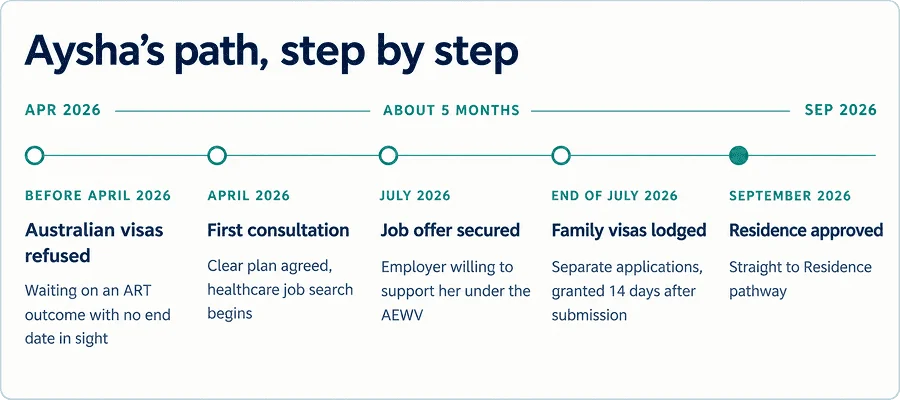
While every case is different, Aysha’s journey moved quicker than she expected.
She began actively searching for employment in April 2026 after her consultation with us. After job interviews, she secured a job offer in July 2026. We then lodged the appropriate temporary visa applications, including separate family visa applications at the end of July 2026, which were granted just 14 days after submission. Residence approval followed in September 2026.
Aysha’s journey shows how a well-planned strategy can create opportunities even when previous immigration experiences have been challenging.
Throughout the process, our team assisted with eligibility assessments, preparing supporting documentation, managing immigration requirements, and ensuring applications were presented as strongly as possible.
What Made This Case Work
- She planned before she searched. A consultation in April set out the full potential pathway before she applied for jobs.
- She secured a healthcare role with an employer willing to support her under the AEWV.
- Her role and circumstances met the requirements of the Straight to Residence pathway.
- Documents and eligibility checks were prepared for her and her family’s separate applications.
Aysha on Life in New Zealand After Australia
Today, Aysha is enjoying life in New Zealand and has established herself in her new community. When reflecting on her decision to move, she says:
“Moving to New Zealand after living in Australia for several years, I don’t feel there is a significant difference in terms of the standard of living. The two countries are quite similar in many ways. The main difference for us is that we previously lived in larger cities in Australia, whereas we are now living in a regional area of New Zealand, so we sometimes need to travel to larger towns or cities to access certain goods and services.
As a Muslim, finding halal groceries is a little more challenging in a regional area, and we occasionally need to commute to the nearest larger city. However, this was also something I experienced in Australia when visiting or staying in regional locations, where there were naturally fewer options compared to bigger cities.
In terms of the people and the sense of community, I have not noticed any significant difference. Overall, my experience has been that both countries offer a very similar lifestyle and community atmosphere.
One additional thing I would like to share from my personal experience is that we have found the cost of living in New Zealand to be a little higher than in Australia, while the pay rates can be somewhat lower. Even so, we would still choose New Zealand in a heartbeat because of the certainty, stability, and peace of mind that residency has given our family.
I am not sharing this to discourage anyone who is considering taking the leap and moving to New Zealand. I simply want people to have a realistic picture and understand that there will always be challenges, and even a place that feels perfect may not make everything easy.
For our family, having New Zealand residency has brought a sense of security, happiness, and certainty about our future. That long-term stability and the opportunities ahead make it all worthwhile for us.”
We would still choose New Zealand in a heartbeat.
Australia vs New Zealand: Her Honest Comparison
| Topic | Australia | New Zealand |
|---|---|---|
| Standard of living | Similar, no significant difference | Similar, no significant difference |
| Community feel | Very similar atmosphere | Very similar atmosphere |
| Where they live | Larger cities | A regional area, with trips to larger towns for some goods |
| Cost of living | Lower | A little higher |
| Pay rates | Higher | Somewhat lower |
| Path to residence | Seven years of struggling, with Expressions of Interest lodged but not selected | Residence granted through the Straight to Residence Visa pathway |
Why She Sought Professional Immigration Advice
When asked why she sought professional immigration advice before starting her New Zealand journey, Aysha shared her perspective:
“I have never handled an immigration application on my own and have always trusted legal professionals because they have the knowledge and experience that most of us simply do not. Sometimes, we do not know what we do not know, and even a small oversight can lead to significant issues or even a visa refusal.
In my case, I was also applying for two New Zealand visas at the same time, including applications for my family members, so I did not want to take any unnecessary risks. Having professional assistance saved me a considerable amount of time and gave me peace of mind throughout the process.
After consulting with David, I gained a clear understanding of the entire process, including the requirements, terms, and conditions set by Immigration New Zealand. This gave me confidence and allowed me to focus my energy on the things that would bring me closer to achieving my goal.”
Why She Chose New Zealand Over Australia
Many people are surprised when they hear that Aysha chose New Zealand instead of continuing to pursue options in Australia. Her answer is simple.
“Australia immigration is strict and narrow. My options were getting fewer and fewer. When we found there was a visa opportunity in New Zealand, we grabbed it within seconds.
New Zealand gave us residency, which we had been struggling to achieve in Australia for seven years. New Zealand has straightforward rules, and Australia also has straightforward rules, but it seemed like I was getting nowhere. I was eligible and lodged Expressions of Interest, but I was not getting selected, maybe because they had reached their quota limit or someone else had higher points. Whereas in New Zealand, if I am eligible and meet the requirements, I am more likely to achieve the outcome.
If I had not sought professional legal advice, I would never have known that it could be this straightforward in New Zealand if your role is on the Straight to Residence pathway and you meet all the requirements. Professional advice helped me understand the available options and gave me confidence to pursue a pathway that I might not have otherwise considered.”
Australia immigration is strict and narrow. My options were getting fewer and fewer.
Advice for Healthcare Workers Applying for NZ Jobs
Aysha also has a message for other healthcare professionals who may be struggling with their immigration situation or finding it difficult to secure employment in New Zealand.
“That’s true that the job market is smaller here. Talking from my own experience, my advice is to keep improving your applications and keep applying. It does not cost money to apply for more jobs, and one application may eventually lead to a job opportunity. In my case, it led to a job opportunity and residency in New Zealand.
Keep trying, keep improving, and do not give up. You never know which application may open the right door for you. As long as you keep taking action, you give yourself a chance to succeed.”
Keep trying, keep improving, and do not give up.
Questions About Moving From Australia to NZ – Temporary-class Visa and Residence-class Visa
1. Can I apply for New Zealand residence if my Australian visa was refused?
A refusal in Australia does not automatically stop you from pursuing a New Zealand pathway, but you will need to declare your immigration history honestly. Your eligibility depends on your own circumstances, so get your situation assessed before you apply.
2. What is the Straight to Residence pathway?
It is a New Zealand residence pathway for people in eligible roles who meet its requirements. Aysha’s role was on this pathway, which is why her family had a clear route to permanent settlement once her job offer was in place.
3. Do I need a job offer first?
Yes, a person would need at least a NZ job offer and must meet all other relevant requirements to be eligible for any skill-based residence visa in New Zealand. A person cannot be eligible for a skill-based residence visa in New Zealand without, at a minimum, having a job offer. The same generally applies to work visas, where you would need to secure a job offer that meets the relevant visa requirements to be eligible for Accredited Employer Work Visa (AEWV), unless you are eligible for another type of work visa, such as a Post-Study Work Visa or Partnership-based work visa.
4. Can my family come with me?
For an AEWV, depending on the skill level of your role, you may be eligible to support your partner and dependent children for visas. For a residence visa, if your partner meets the eligibility requirements to be included in your residence application, they can be included.
5. In the case that I am fully eligible for any type of NZ skill-based resident visa, how long does it take from visa application to visa decision?
The current processing time at INZ is between 8 and 9.5 weeks, although it may be shorter or longer depending on INZ’s capacity at the time and the circumstances of each application. We would suggest lodging a decision-ready application, as this may assist INZ in reviewing the application efficiently and potentially help avoid unnecessary delays.
Check Your Eligibility for NZ Residence
Aysha’s story shows that immigration journeys are rarely straightforward, but setbacks do not always mean the end of the road. For professionals seeking greater certainty, career opportunities, and a pathway to residence, New Zealand may offer possibilities worth exploring.
While many people talk about Kiwis moving to Australia and limited job opportunities in New Zealand, Aysha kept an open mind. If she had accepted those assumptions without exploring her options, she would not have found the healthcare opportunity that led to her New Zealand residence.
One decision to explore an alternative pathway changed the course of her family’s immigration journey. From her first consultation with us in April 2026 to New Zealand residence in September 2026, their situation transformed within five months. This does not happen to everyone, but it is more likely for those who believe there may be opportunities out there and take action to pursue them. Sometimes a different path leads to the destination you have been working towards all along.
Not sure if a New Zealand pathway is open to you?
Our team at Immigration Chambers will assess your options and explain what may be available.
Every case is different. Aysha’s result does not guarantee a similar outcome for anyone else. Immigration rules and processing times change, so check current requirements with Immigration New Zealand or a licensed immigration adviser.